The Appleton CoreCivic Concentration Camp ^
Show Up & Protest
Every Thursday
Resist!
- When:
- Every Thursday, 5:00–6:30pm
- Where:
- Flags of Honor Site
Appleton, MN
Core Civic opens a private detention center August 11 in Appleton, MN
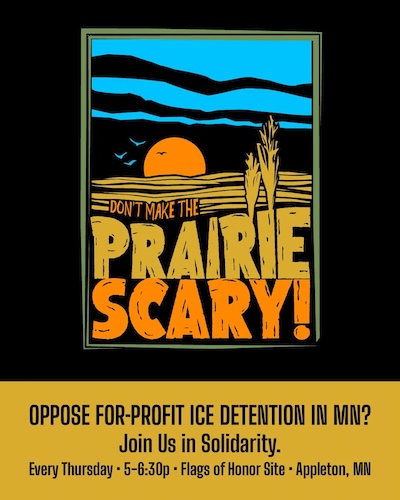
Swift County Fair
Organizers local to the Appleton, MN area also be talking with attendees at the Swift County Fair. If you're interested in connecting more, email misty@curemn.org.
Other possibilities?
Appleton MN is far away for us. In the Twin Cities folks have proposed
chartering a bus to & from a Thursday action & using the time on the
road for training / organizing / making stuff. But we are much farther away.
Ideas? How can we show our support for local resistance efforts in Appleton &
stand up against this huge, privately-managed ICE detention camp?
Local News ^
Coverage from different sources
ICE, CoreCivic to open Appleton immigrant detention center this year
It will be the first detention center of its kind in Minnesota
Minnesota Reformer
"Immigration and Customs Enforcement will pay private prison company CoreCivic more than half a billion dollars to reopen a defunct 1,600-bed prison in rural western Minnesota as an immigrant detention center.
"CoreCivic runs some of the country’s largest and most infamous immigrant detention centers, including the Dilley Immigration Processing Center in Texas... Disease outbreaks, lack of medical care, inedible food and lack of outside time are common complaints."
Homeland Security buys former prison in west-central Minnesota for $500 million
Late breaking news
MPR
"A day after it was announced that a former private prison in west-central Minnesota will be used to house ICE detainees, the company running the facility has announced the former prison’s sale to the U.S. government for half a billion dollars.
"The private prison company CoreCivic said in an investors statement that they've sold the 1,600 bed Prairie Correctional Facility in Appleton, Minn., to the U.S. through the Department of Homeland Security for $495.6 million. CoreCivic will still manage the facility, which is expected to start receiving ICE detainees this fall and be up to full capacity by mid-2017."
AFSCME Council 5 Strongly Condemns ICE–CoreCivic Contract to Reopen Appleton Private Prison
"AFSCME Council 5 strongly condemns the decision by ICE to contract with CoreCivic to reopen the Prairie Correctional Facility in Appleton, MN as a for-profit, private immigrant detention center. This decision is morally wrong, dangerous, and more costly for communities across Minnesota, and is fundamentally at odds with the values of dignity, justice, and respect that we hold dear as Minnesotans.
"No corporation should generate revenue and profit from imprisoning human beings, separating families, and expanding a for-profit detention industry that treats human beings and workers as sources of profit for shareholders. When a corporation’s revenue depends on keeping more people locked behind bars for longer periods of time in dangerous conditions and having poorly trained and equipped staff on site, safety and human dignity will always come second to the company’s bottom line."
First Private ICE Detention Facility in the State Sets a Dangerous Precedent
The Immigrant Law Center of Minnesota issues a statement
"The Immigrant Law Center of Minnesota (ILCM) is appalled at the U.S. Immigration and Customs Enforcement (ICE) detention facility set to open in Appleton, Minnesota. At 1,600 beds, the CoreCivic facility would be the first private ICE detention facility in the state and among the largest carceral facilities in Minnesota.
"It’s a staggering increase over the immigration detention capacity currently contracted to county jails. ILCM warns that the facility’s scale and its remoteness threaten the ability of detained people to access legal counsel. Across the country, immigrants in detention centers are denied healthcare, living in overcrowded spaces, and treated barbarically.
"ILCM denounces privatized detention as a revenue stream. A system that pays a private company per person, per day creates an incentive to take people away and detain them for longer. As Operation Metro Surge and other actions have shown, incentivizing detentions incentivizes violence against communities, violations of civil rights and civil liberties, and further dehumanization of immigrants and refugees."
An ICE Concentration Camp Is Coming To Minnesota
On that choice of naming
Indivisible Twin Cities
"After the siege on our state by out-of-control federal agents who flagrantly ignored the law, it is an insult to our communities to open a for-profit concentration camp in our state. We oppose any concentration camp in Minnesota, or anywhere else.
"We choose the term 'concentration camp' intentionally. We will not soften the wording of what this facility will be used for because we have watched what has occurred in other camps across the country.
"According to the Merriam-Webster dictionary, a concentration camp is defined as 'a place where large numbers of people, especially political prisoners or members of persecuted minorities, are deliberately imprisoned in a relatively small area with inadequate facilities.'
"Reports of physical abuse, lack of adequate medical care, rotten food, unsanitary conditions, and even death, have shown us that companies like CoreCivic and The GEO Group do not have any empathy or concern for the humans in their custody.
"DHS has flagrantly ignored any attempt at congressional oversight of these facilities across the country. Congress has the responsibility to provide oversight but members have been turned away at the facilities in their districts and states. We must demand they be allowed to do their jobs."
Say NO to an Appleton ICE Detention Center
An earlier summary from CURE MN
"Minnesotans saw this winter how ICE and its detention network are being used to systematically deprive people of their rights, often without regard to legal status. The Trump administration’s plan for a vast private prison network threatens to extend these harms and erode our democracy.
"A 1,600-bed private ICE detention center would have serious consequences for Appleton, Swift County, and the broader region. Residents have not been given meaningful information to understand what is being proposed, who is making the decisions, or what costs the community may be expected to absorb. Residents haven’t been given adequate opportunity to ask questions or provide their views. We are concerned about the strain this facility could place on local housing, healthcare, emergency response, public safety, transportation, and other city and county resources. Rural communities should not be left to manage or pay for the fallout of federal detention expansion while private prison corporations garner all the benefits for their investors.
"As rural Minnesotans, we care for our immigrant neighbors who are raising families, running businesses, and building lives in the small towns we call home. We recognize that they love these communities like we do. Many of us carry our own family histories of immigration to this place in search of a better life. No one is safer or better off when our government denies people their rights and due process under the law. The prison should not be reopened as a for-profit private ICE detention center."
Long-shuttered Appleton, Minn., prison to reopen for ICE detainees
The 1,600-bed prison is expected to open this fall. Contractors started repairs on the facility last year.
MN Star Tribune (Gift link)
"The privately owned prison in Appleton, Minn., that was shuttered 16 years ago will reopen in the fall to hold detainees for U.S. Immigration and Customs Enforcement.
"Owner and private prison operator CoreCivic announced a five-year deal Tuesday with the U.S. Department of Homeland Security to house up to 1,600 ICE detainees. The reopening will happen in stages, and the prison is expected to be fully operational by next spring.
"CoreCivic is one of the largest government contractors for immigrant detention and recently sold two California detention facilities to DHS for $1.5 billion.
"Lauren-Brooke Eisen, senior director of the Brennan Center’s Justice Program at the NYU School of Law, said federal officials are increasingly reliant on private prison contractors to hold immigrant detainees. The move comes after communities nationwide pushed back against ICE’s attempts to retrofit warehouses as detention facilities.
"State Sen. Ron Latz, DFL- St. Louis Park, chair of the Senate Judiciary and Public Safety Committee, said Minnesota banned the use of private prisons in 2023. He said he’ll explore ways to stop the facility from reopening.
"'The planned use of Appleton Prison as an ICE detention center is an affront to all Minnesotans, who have soundly rejected the barbaric immigration policies and practices of this administration,' Latz said in a statement. 'No one should be detained for profit and a corporation’s bottom line.'
"Under President Trump the number of immigrants in ICE custody has soared from about 40,000 to more than 65,000. Increasingly, these detainees are being held in facilities owned or operated by for-profit prison companies.
"Contracts for immigrant detention provide about 35% of CoreCivic revenue, according to company financials.
"Detention centers across the U.S. have been accused of holding immigrants in unsanitary conditions, serving them spoiled food and providing poor medical care. There have been 55 deaths in immigrant detention since Trump returned to office."
Minnesota banned private prisons. ICE is bringing one back anyway
DOC commissioner: The state cannot stop DHS’ apparent plans to open a privately-run ICE detention center in Appleton, Minn. But we should speak loudly against it.
MN Star Tribune (Gift link)
"The company reported $116.5 million in profit in 2025, nearly 70% higher than the year before. During earnings calls, analysts complained that Immigration and Customs Enforcement (ICE) isn’t detaining people fast enough to maximize returns. This is not a public safety partnership. It is a business that grows more profitable with every person detained.
"DHS is not claiming Minnesota lacks detention capacity. Rather, it wants to make an example of our state again, detaining people from across the country — individuals with no connection to Appleton and who would be separated from legal counsel, family and meaningful oversight.
"As a leader of our state’s correctional facilities, I know what safety and security look like when done well and what the human impact is when it isn’t. Minnesota is once again being forced to absorb the consequences of a reckless and poorly implemented effort that will likely result in more unnecessary deaths, family separations, community outrage and significant local impacts.
"According to reporting by the Guardian, 2025 was the deadliest year for ICE detention in two decades with 32 people dying while in custody. Most people held in these facilities have not been convicted of crimes. They are parents, working people and neighbors awaiting administrative immigration proceedings. Yet congressional investigators and federal inspectors have documented medical neglect, malnourishment, punishment and denial of care, including for pregnant women. Inspectors call these conditions barbaric."
When Do 'Detention Centers' Become 'Concentration Camps'?
Experts Look to History
The Marshall Project
"Concentration camps are most often associated with the worst of Nazi Germany: extermination camps designed for systematic mass murder. But concentration camps, which are defined differently, have existed for more than a century in several countries — including the U.S.
"Modern concentration camps date back to the 1890s, with the inventions of barbed wire and automatic guns, which made controlling large groups of people easier, Pitzer told The Marshall Project. Around the turn of the 20th century, concentration camps were used by the British in South Africa and by the Spanish in Cuba.
"In her 2018 book, 'One Long Night: A Global History of Concentration Camps,' Pitzer wrote that concentration camps involve the mass detention of civilians, without due process or a full trial, based on their identity, rather than something they had done.
"While Immigration and Customs Enforcement agents go after people who don’t have authorization to be in the country, observers note that they have expanded their purview in the past year, arresting people with legal protections and green cards, and even U.S. citizens. Pitzer also pointed to Trump’s use of disparaging language toward specific groups, saying this suggests that certain people, like those of Somali and Haitian descent, are targeted based on their identity.
"While ICE has legal authority to detain people based on their immigration status, agents are acting with 'extralegality,' said Waitman Beorn, a Holocaust historian at Northumbria University in England, pointing to instances of ICE blocking oversight, hindering access to legal counsel and transferring people to far-flung facilities in an apparent effort to isolate and confuse them.
"There isn’t a specific point at which a facility becomes a concentration camp, but Pitzer said that the U.S. has crossed that line today.
"Beorn said the term 'needs to be demystified, meaning that something does not have to be Auschwitz to be a concentration camp.'
"Concentration camps evolve within a system. Before there were established camps in Nazi Germany, Beorn said, victims were sent to improvised sports arenas and warehouses.
"He said what the U.S. detention centers 'resemble is the early period of Nazi concentration camps.'"
Learn more
We have gathered more news coverage & analysis.
This includes an in-depth look at the choice to call this type of detention center a "concentration camp"
from writers & historians. What can we learn from the past?
Let's learn together & share with our communities. How can we join together to
rise to these times?
Voting Rights ^
& Threats to Elections
Who Gets Voting Rights?
Civics Made Easy from PBS
In this episode of Civics Made Easy, Ben Sheehan uncovers the surprising – and often overlooked – true history of voting rights in America. From the founding era to Reconstruction to Civil Rights to today, this is the story that may not have been fully taught in school.
Organizing to Protect Democracy
How elections work (from the ACLU)
In a moment when our right to vote is facing relentless attacks, understanding how elections work has never been more important.
Now, we have the electoral knowledge and skills to be active in protecting our democracy.
Election Protection
from Common Cause
"We will place thousands of volunteers on the ground, and recruit a team of legal experts to staff the 866-OUR-VOTE hotline. Common Cause is a crucial line of defense for voters against suppression tactics, confusing laws, outdated infrastructure, and other impediments to making themselves heard. Above all, we inform voters of their rights, help elections officials handle problems in real time, and notify legal teams when the courts’ interference is needed.
"State-by-state, we place trained poll monitors at polling places, especially in communities with a history of voting problems, where hotly-contested races exacerbate the chance of long lines, confusion, and other complications. We’ll also be in states where there may be confusion about voter ID requirements. Poll monitors will provide information, troubleshoot problems, and report bad practices to our teams to resolve them with election officials."
Voting & Elections
from the Brennan Center for Justice
"Americans still face many barriers to voting. Meanwhile, elections require secure systems and independent administration of the casting and counting of ballots. The Brennan Center fights for voting rights, and we advocate for plans that will safeguard the election system — and the officials who work in it — from attacks and political interference."
The People’s Guide to Voting Rights
from Democracy Forward
"This guide covers the voting landscape of the 2026 midterm elections and informs voters about their rights and options
Democracy is not self-sustaining. It requires constant defense in courtrooms, in legislatures, in the streets, and at the ballot box."
Federal Agents at the Polls
from the ACLU
"Americans still face many barriers to voting. Meanwhile, elections require secure systems and independent administration of the casting and counting of ballots. The Brennan Center fights for voting rights, and we advocate for plans that will safeguard the election system — and the officials who work in it — from attacks and political interference."
Oppose the SAVE Act
Write to your Legislators
..."if anything like this ever did become law, the cleanest single document would likely be a valid U.S. passport in your current legal name, because it proves citizenship directly. A REAL ID driver’s license would not, by itself, count as proof of citizenship under this proposal. People with name changes could be forced to assemble a full paper trail connecting birth certificates, marriage licenses, divorce decrees, or court orders to their current legal identity."
Election Chiefs Decry SAVE America Act
from Democracy Docket
"The bill’s restrictions on the right to vote also aren’t hypothetical: Similar laws passed by states in the past led to widespread disenfranchisement, Simon said. He highlighted Kansas’ Secure and Fair Elections (SAFE) Act in 2011.
"Though noncitizen registration in the state was statistically nonexistent, Kansas adopted SAFE and mandated that prospective voters show documentary proof of citizenship to register. That requirement, which has since been blocked by federal courts, prevented over 31,000 eligible citizens from registering to vote.
"'This isn’t some theoretical or imagined circumstance,' Simon said.
'This bill assumes that every voter can navigate these requirements and navigate them quickly, and that is just not reality,' Connecticut Secretary of State Stephanie Thomas (D) said before raising specific examples of people who could be affected by the bill’s proof of citizenship requirements.
"'Imagine a woman, divorced, she’s moved, changed her name and needs to update her voter registration,' Thomas said. 'Under this bill, that is no longer a simple matter. It means tracking down multiple documents.'
'Or imagine an 82-year-old man, he just moved into assisted living. He’s voted his entire life. He’s never had a passport. No one knows where his birth certificate is at this point, and he doesn’t have a family member to help him use a computer,' she added. 'That lifelong voter could be blocked, not because he’s ineligible, but because he can’t produce the right document at the right time.'"
Stacey Abrams on Voter Supression
from NPR
"Stacey Abrams is one of the most high-profile voting rights activists in the U.S. She says whether we have an actual democracy might literally depend on protecting voting rights in the next election cycle or two. How to prevent that? Keep an eye on the 10 steps from democracy to autocracy."
Fact Check: Voting Fraud is Rare
from the AP
"The nation’s multilayered election processes provide many safeguards that keep voter fraud generally detectable and rare, according to current and former election administrators of both parties."
Documentary Proof of Citizenship (DPOC) Laws Action Kit
League of Women Voters
"DPOC laws require individuals to provide physical documentation--a passport, birth certificate, or naturalization papers--proving U.S. citizenship before registering to vote or requesting a ballot."
Resist efforts to pass these laws.
This resource explains why DPOC laws are harmful and how you can fight back.
What is Gerrymandering
An easy explainer on gerrymandering from Red Wine & Blue
"Once voters understand what gerrymandering is, they agree that it undermines our democracy. We all want our votes to count fairly and equally. Elections should be decided by voters, not by the politicians themselves before we even get to the polls!"
Delivering the Vote
How 4 pressures are testing the Postal Service’s role in American elections
"Every election cycle, tens of millions of Americans vote without setting foot in a polling place. Their local election office mails them a paper ballot, they mark it at home, and they hand it back to a letter carrier to return. Over the past three decades this has grown from a niche convenience into how almost a third of the country votes: the share of voters casting a ballot by mail rose from 7.8% in 1996 to 21% in 2016, surged to 43% in the pandemic election of 2020, and settled at 29% in 2024 (Figure 1). In that election, the U.S. Postal Service (USPS) carried roughly 99 million ballots to and from voters.
"That national average masks wide variation among the states: in Oregon and Washington, more than 95% of voters cast their ballots by mail, while in West Virginia and Tennessee fewer than 3% do.
"That scale turns a question most people never think about into an urgent one: what, exactly, is the Postal Service’s job in an election?"
Safe Elections ^
Protecting the right to vote
2025 Minnesota Statutes
Conduct in and near polling places
"An individual must be allowed to go to and from the polling place for the purpose of voting without unlawful interference. Except an election official or an individual who is waiting to register, to update the voter's registration, or to vote or an individual who is conducting exit polling, an individual must not stand within 100 feet of the building in which a polling place is located..."
Democracy on the Block Organizer Toolkit
from MN Voice
"DOB gatherings are celebratory community care events intended to promote voter participation and civic engagement at a precinct level. Gatherings are organized and hosted by teams of local volunteers, all of whom will receive Democracy Observer training through Minnesota Voice.
"Across the country, BIPOC, native, and immigrant voters are facing increased uncertainty around their right to vote in the 2026 election. One major concern is that immigration enforcement officers will expand their operations in communities and target polling sites to suppress voter turnout and encourage division among communities.
Democracy On The Block gatherings direct communities to combat dangerous narratives by reframing elections through the lens of community care. Through boots-on-the-ground organizing, connection to supportive live community calls, voter education, and community collaboration, Democracy On The Block reaffirms voting as a joyful expression of community power, and upholding our rights under the constitution."
Act Free to Be Free
A State and Local Pro-Democracy Framework A Civil Society Framework for Election Defense in 2026
"Anyone paying attention knows that Donald Trump is not preparing to lose the 2026midterms. He is preparing to disrupt and sabotage them, and his administration has beenlaying the groundwork for months.
"The harder problem is this: most of us (organizers, elected officials, legal advocates,pro-democracy funders) are still preparing for a normal election. We are running electionprograms. We are testing messages. We are mobilizing voters. These are not wrong thingsto do. They are profoundly insufficient for the threat we are actually facing.
"There is also something harder to name, a kind of collective avoidance. An unwillingness tofully believe our own eyes. Many Americans have internalized a story about ourselves thatsays we are immune from this kind of thing. We are not. And the next six months willmatter enormously for how far down the abyss we go."
Safe & Secure Elections
Minnesota 2026 Law Enforcement Quick Reference Guide
This pocket guide provides key parts of the state law pertaining to
election interference.
Hands Off Our Vote
from Indivisible
"In 2026 we are building our strongest election protection program ever, in all 50 states. We’re going to bring Indivisible’s grassroots organizing force out to ensure that whatever tricks they try to hold onto power, we’ll be ready."
Observer vs. Monitor
The biggest obstacle to the Trump DOJ’s election monitors? The right’s long attack on federal oversight
"Legally, two types of federal officials can oversee elections in some capacity: federal observers and federal monitors.
"Established by the Voting Rights Act, election observers are federal agents from the Office of Personnel Management who work with the DOJ’s Civil Rights Division to directly monitor elections.
"They can go inside polling places at all stages of the voting process, from polls opening through ballot counting, all while closely watching poll workers, voters and election machines.
"Federal election monitors, on the other hand, are Civil Rights Division attorneys deployed to ensure that states and localities are complying with federal voting and accessibility laws, such as the Help America Vote Act and the Americans with Disabilities Act.
"In general, the Civil Rights Division can deploy monitors to any jurisdiction, for any election — though, unlike observers, they are severely limited in their ability to oversee election processes.
"While monitors are meant to ensure compliance with federal law, they can only do so through limited observations. They have no law enforcement authority while monitoring. As such, it’s generally believed that they cannot enter polling places without a state’s consent, are subject to state election laws and have to openly identify themselves as monitors.
"Becker likened monitors to 'flies on the wall.'"
A Guide to Election Observer Policies in the United States
from the Carter Center
"Observers are trained to
attentively watch without interfering. They examine
not only Election Day activities, such as the casting
of ballots, but also pre-election and postelection
processes... Nonpartisan observation can provide a particularly
important way for citizens to encourage accountability
in the democratic system outside of party structures"